

Mountain Modern Fence Ideas for Canada: Steel, Cedar and Corten for BC and Alberta
BarrierBoss Style Guide · Canada
Mountain Modern Fence Ideas for Western Canada: From the Bow Valley to the Sea-to-Sky
Timber, stone, glass and dark steel: contemporary mountain homes in Canmore, Revelstoke, Whistler and the Kootenays share a look, but the fence around them has to deal with things a city fence never sees. Four metres of snow a winter. Elk in the driveway and bears in the fruit trees. Wildfire smoke in July and August. This guide covers how to design a mountain modern fence that suits the house and the mountain town it sits in, with eight ideas from across BC and Alberta.

What You Need to Know (TL;DR)
- A good mountain fence repeats the materials of the house: dark steel, natural cedar and stone, with long clean lines and open sections where the view matters.
- Snowfall varies hugely between mountain towns. Environment Canada normals put Whistler at about 419 cm a year and Revelstoke at about 381 cm, compared with about 159 cm in Golden.
- Fences don't stop bears. WildSafeBC recommends electric fencing to protect chickens, beehives, fruit trees and gardens, so plan for it from the start.
- Keep the first 1.5 metres around the house non-combustible. FireSmart guidance calls for a metal gate or panel to break any wood fence where it meets the home.
- Check your municipality's rules first. In Canmore, a fence that meets the Land Use Bylaw height limits needs no permit, but corner sightlines are capped at 1.0 m.
The Timber, Stone and Steel Look of BC and Alberta Mountain Homes
The mountain modern style grew out of the western ski towns: big timber frames and heavy stone, opened up with walls of glass and topped with simple metal roofs. In Canada, it ranges from new builds on the benches above Canmore to cedar-clad homes in Revelstoke, Fernie and Rossland, to contemporary chalets tucked into the trees at Whistler and Sun Peaks.
A fence for these homes should follow the same rules as the architecture: few materials, honest finishes and lines that sit low against the landscape. Dark steel matches black window frames and metal roofs. Western Red Cedar matches the timber. Open wire keeps the view of the peaks, and solid panels go only where you need privacy.
Steel also suits the conditions. It doesn't rot under snow, it doesn't need restaining after a dry summer, and it won't burn. Browse every profile in this guide in our metal fence panels collection.
Snowfall in Canadian Mountain Towns and What It Means for a Fence
"Mountain town" covers very different winters. These are average annual snowfall totals from Environment Canada climate normals:
| Town | Average snowfall per year | What it means for the fence |
|---|---|---|
| Whistler, BC | About 419 cm | Plan for deep, heavy snow against the fence and gates that open above the snowpack. |
| Revelstoke, BC | About 381 cm | Wet Interior Wetbelt snow. Leave room to clear snow away from panels. |
| Sparwood, BC (Elk Valley) | About 264 cm | Similar to Fernie conditions. Open wire sections help where snow drifts. |
| Castlegar, BC (West Kootenay) | About 201 cm | Steady snow and wet spring melt. Metal posts help on soggy ground. |
| Banff, AB | About 184 cm | Lighter, colder snow and strong valley winds. Secure solid panels well. |
| Golden, BC | About 159 cm | Cold winters with deep frost. Check post depth carefully. |
| Kelowna, BC (for comparison) | About 64 cm | Valley-floor Okanagan. Higher resort areas get far more. |
Snow shapes a fence in three ways. Solid panels act like a snow fence and pile drifts on the downwind side, so keep long solid runs away from driveways and walkways you need to clear. Snow pushed by a plow or shovel adds a lot of weight against the bottom of a panel, so leave a strip along the fence where snow can sit without being banked up. Gates need to swing over a snowpack that can sit higher than the bottom rail for months, which shapes where you put them and which way they open. Our guide on winter-proofing a fence and gate covers the seasonal checks.
Fencing in Bear, Elk and Deer Country
In most Canadian mountain towns, wildlife moves through yards as a matter of routine. That changes what a fence can and should do.
Bears
A regular fence won't keep a determined bear out of a garden, a chicken coop or a fruit tree. WildSafeBC calls electric fencing a very safe and effective way to keep bears away from livestock, beehives, fruit trees and other attractants. For a steel garden fence, that means adding a strand of electric wire on insulators along the outside, sized and grounded to WildSafeBC's guidelines. Check your local bylaws first: some communities require electric fencing for backyard chickens and bees, and some restrict where it can go.
Elk, deer and wildlife corridors
Towns like Canmore sit inside busy wildlife corridors, and the Town of Canmore's Community Standards Bylaw addresses wildlife attractants such as fruit and compost. Elk and deer will eat a garden down to the soil, so a tall, rigid fence around the vegetable beds is worth it. Around the rest of the property, think about what the fence blocks. A solid barrier across a slope that animals use every day can push them toward roads and neighbours.
Acreage boundaries
On larger rural lots, Alberta Conservation Association guidance favours wildlife-friendly wire on long boundary runs: a top wire no higher than about 102 to 107 cm (40 to 42 inches) and a smooth bottom wire high enough for pronghorn and young animals to pass under. Save framed steel panels for the house yard and gardens, and use wildlife-friendly wire on the outer edges.
FireSmart Rules for Mountain Properties
Timber-and-glass homes in the mountains often sit in the trees, which puts them in the wildland-urban interface. FireSmart BC describes the Immediate Zone as the first 1.5 metres around the house and attached structures, and says it should be non-combustible. A wood fence that runs up to the house can carry fire straight to the wall, and FireSmart's fence guidance is to keep at least a 1.5 metre non-combustible break between any wood fence and the home, for example with a metal gate.
That makes steel the logical choice for the stretch of fence nearest the house, even if you use cedar-framed panels further out. Our guide to FireSmart fence design covers how to lay out the zones and what to plant near the fence.
Permits, Bylaws and Strata Guidelines
- Municipal height limits. Most mountain municipalities set fence heights in their land use or zoning bylaw. In Canmore, a fence that meets the Land Use Bylaw heights doesn't need a development or building permit, and fences in the corner visibility triangle are capped at 1.0 m (40").
- Stratas and design guidelines. Many resort subdivisions and strata developments in places like Whistler, Sun Peaks and Silver Star have architectural guidelines covering fence height, material and colour. Get written approval before you order.
- Wildlife and attractant bylaws. Some towns regulate fruit trees, compost, chickens and bees, and some regulate electric fencing. Check before you add a strand.
Our guide to fence permits in Canada covers the common rules by province.
Fence Colours Taken From the Peaks
Take the palette from the mountain itself: dark timber, grey rock, rusty iron-rich soil and the bright white of winter.
- Black: matches black window frames and metal roofs, and it reads sharply against snow. The most popular choice for contemporary mountain homes.
- Grey: sits quietly beside granite, limestone and concrete. A good fit for homes built on rock.
- Brown: blends with timber and forest, so the fence recedes into the trees.
- Corten: genuine weathering steel that turns a deep rust colour, warm against snow and grey stone.
- Silver: bare galvanized hog wire for a plain, working look around gardens and outbuildings.
Our privacy panels are 26-gauge galvanized steel, painted on both sides with high-durability polyester (HDP) paint. The colour resists fading in strong high-elevation sun, and both sides of each panel are identical, so the neighbour's side looks as finished as yours. Corten is the exception: it isn't painted at all.

8 Mountain Modern Fence Ideas
1. Cedar-framed ribbed steel for a Revelstoke timber home
Deep-groove ribbed steel throws strong vertical shadow lines that suit a timber-frame home, and a Western Red Cedar frame ties the fence to the beams and soffits. Our cedar-framed ribbed steel panels come in black, grey, brown or Corten, set vertical or horizontal. Use them where you want privacy, like a hot tub deck or a side yard facing a neighbour.
2. Corten against the stone of the Bow Valley
Canmore and Banff homes lean on limestone and grey rock, and Corten's rust tones look right beside them. Corten steel fence panels are genuine weathering steel, not painted. They arrive as bare steel and develop their rust patina over several weeks to a few months, and the runoff in that early stage can stain concrete, pavers and stone, so keep the fence off a light-coloured patio or set it over gravel. See more in our Corten collection.
3. Open black wire facing the view
On the side of the lot that looks at the peaks, don't block the reason you bought it. A black wire fence almost disappears at a distance, so the view comes through clean. The rigid 6-gauge panels hold their shape under snow, and the open grid lets wind and blowing snow pass instead of building a drift.
4. A bear-aware kitchen garden in the Kootenays
In Nelson, Rossland and the Slocan Valley, a garden fence has to handle deer, elk and bears. Tall hog wire fence panels in cedar frames keep deer and elk out and look far better than temporary mesh. Add an electric strand on the outside to WildSafeBC's guidelines to keep bears away from the beds, and choose 2" x 2" or 1" x 1" mesh where rabbits and squirrels are a problem.
5. Grey horizontal steel for a chalet in the trees
In Whistler and Sun Peaks, many homes sit in dense forest, close to their neighbours. Grey steel panels run horizontally give privacy without adding another dark mass under the trees, and they suit the long lines of a contemporary chalet. Check your strata or design guidelines before you choose the colour.
6. All-steel near the house in wildfire country
For the fence nearest the house, especially in the dry Interior, go fully non-combustible. The zero-maintenance black hog wire fence kit sets 6-gauge wire in a black steel frame with steel posts, so there's no wood at all. It ships as parts and bolts together on site. For a solid version, the zero-maintenance black metal privacy fence kit does the same with corrugated or ribbed panels.
7. Stone piers with steel between them at the entry
At a mountain home's front entry, a few stacked-stone or concrete piers with steel panels between them give the fence the weight of the architecture without a solid wall. Black steel against grey stone is a classic mountain pairing. Keep the run short and use it to frame the driveway or front walk.
8. Wildlife-friendly wire beyond the yard on an acreage
On a Golden, Invermere or Elk Valley acreage, fence the house yard, garden and dog run in steel, then switch to wildlife-friendly wire for the long boundary runs. That keeps the area around the house tidy and secure while leaving elk, deer and moose room to move across the rest of the land.

Posts, Frost and Gates at Elevation
Frost tends to go deeper at elevation and in cold valleys, and posts that aren't set below it can heave. Check the typical frost depth for your area in our frost line guide by province before you dig, and confirm with your municipality or installer.
Metal fence posts are a true 4" x 4" in black, in 6', 9' and 12' lengths. They won't rot in wet spring melt, which makes them the better choice on soggy ground. Wood fence posts in pressure-treated lumber are kiln dried before treatment (KDBT). If you cut one on site, seal the cut end with two coats of copper-based end-cut preservative containing at least 1% copper.
To count posts, start with the number of panels in each straight run and add one, then add one more post for every gate opening. With 6' or 8' panels, the panel width sets your post spacing.
For gates, think about winter first. Hang them where snow won't bank up against them, plan the swing so it clears the snowpack, and make sure the opening is wide enough for a snowblower or a plow. A matching fence gate keeps the design consistent, and the all-steel zero-maintenance metal fence gate is the choice where the fence meets the house in fire country. Price your run with the BarrierBoss fence configurator.
- Counting on a fence to stop bears. Deal with attractants first, and use an electric strand where you need real protection.
- Long solid runs beside the driveway. Solid panels pile drifts on the downwind side, right where you need to clear snow.
- Banking plowed snow against the fence. Leave a strip along the fence where snow can sit, and pile cleared snow somewhere else.
- A wood fence attached to the house. FireSmart guidance calls for a non-combustible break of at least 1.5 metres between a wood fence and the home.
- Fresh Corten over a light patio. Early runoff stains concrete, pavers and stone while the patina forms.
- Ordering before the strata approves it. Resort subdivisions often control fence height, material and colour.
- Fencing across a wildlife path. A solid barrier where elk and deer cross every day pushes them somewhere worse.
Frequently Asked Questions
What is the best fence for a mountain modern home in Canada?
Steel paired with cedar or stone suits the style best. Use solid corrugated or ribbed steel where you need privacy, open hog wire where you want to keep the view, and all-steel panels nearest the house in wildfire areas. Choose black, grey, brown or Corten to match the house.
Will a metal fence hold up to heavy mountain snow?
A properly installed steel fence handles snow well. It won't rot or warp, and BarrierBoss steel carries a 40-year warranty. Keep plowed and shovelled snow from being banked against the panels, set posts below the frost line, and use open wire where drifting is a problem.
Will a fence keep bears out of my yard?
Not on its own. WildSafeBC recommends electric fencing to protect specific attractants like chickens, beehives, fruit trees and gardens, along with managing garbage, compost and fallen fruit. A steel garden fence with an electric strand on the outside is a strong combination.
Do I need a permit to build a fence in Canmore?
Not if it meets the height limits in Canmore's Land Use Bylaw. Fences in a corner visibility triangle are limited to 1.0 m (40"). Check the bylaw before you build, and check with your strata if you're in one.
What fence is best for FireSmart in the mountains?
Non-combustible steel, at least for the 1.5 metres closest to the house. FireSmart guidance calls for a metal gate or panel to separate any wood fence from the home. All-steel kits with steel posts and frames leave no wood anywhere in the fence line.
How deep should fence posts be in the mountains?
Below your local frost line, which is often deeper at elevation. Our frost line guide gives typical depths by province, but confirm with your municipality or a local installer, since mountain conditions vary a lot from one valley to the next.
Build a Fence That Belongs in the Mountains
BarrierBoss corrugated, ribbed and Corten steel panels, cedar-framed or all-steel, and rigid 6-gauge hog wire are built in West Kelowna for BC and Alberta conditions. Choose the panel for each part of the property, from the hot tub deck to the garden to the view.
Shop Steel Fencing → Shop Hog Wire → Size Your Project →
Made in West Kelowna and brought to your property on our own trucks, then unloaded by our crew. See delivery details
Shop These Products
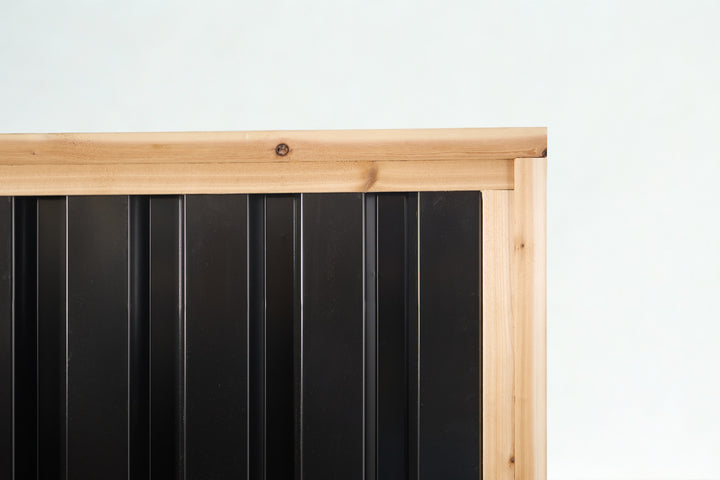
Ribbed Metal Privacy Fence Panels, Cedar Frame
Timber-frame warmth, steel strength. Deep-groove 26-gauge galvanized steel, painted on both sides with HDP paint, in a Western Red Cedar frame. Black, grey, brown or Corten, vertical or horizontal.
From C$256.49 / panel
Corten Steel Fence Panels
Rust tones for snow and stone. Genuine weathering steel, not paint. It arrives bare and forms its own rust patina over several weeks to a few months. Framed or unframed.
From C$95.99 / panel
Zero-Maintenance Black Hog Wire Fence Kit
Open, all steel and nothing to burn. Rigid 6-gauge wire, hot-dipped and heavy galvanized, then dip-coated, in a black steel frame with steel posts. Ships as parts and bolts together on site.
From C$515.99 / kitShop Fencing
Made in BC, Delivered by Our Own Crew
Every BarrierBoss panel is built in West Kelowna, BC, and our own trucks deliver across BC and Alberta, with residential delivery and unloading included. Read the shipping policy for delivery areas and timing.