

Your information source for all things fencing, siding, and roofing -- and more.
Fence guides & ideas
Search 126 articles on metal privacy, hog wire and cattle panel fencing.
-


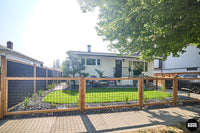
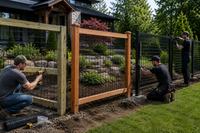
Customer Story: A Black Hog Wire Fence on the Forest’s Edge in Comox, BC
After 17 years without a fence, a Comox family needed to keep stray dogs and trail traffic off their property without walling off the forest behind it. About 60 feet of black hog wire did both, installed in under three days.
-


Mountain Modern Fence Ideas for Canada: Steel, Cedar and Corten for BC and Alberta
Mountain modern homes in Canmore, Revelstoke, Whistler and the Kootenays need a fence that matches the timber, stone and glass, and that stands up to four metres of snow, wildlife in the yard and wildfire season. Here are eight steel and cedar fence ideas built for Canadian mountain towns.
-


Modern Cottage Fence Ideas: Beyond Traditional Wood
How to fence a modern cottage without blocking the lake: cedar and steel pairings, privacy for the hot tub, fences that survive the months you’re away, and the shoreline and FireSmart rules to check first.
-


Hog Wire vs. Chain Link: A Better Fence for 2026
Chain link has been the default budget fence for decades: quick to install and instantly recognizable, but built for the bare minimum. If you want the same practicality with far better strength, security, and looks, hog wire is the upgrade worth making. Here's how the two compare, and why 6-gauge welded hog wire outlasts and outclasses a chain link fence.
-


The Canadian Guide to Chain Link Fencing
Chain link has been the default budget fence for decades, affordable, strong enough, quick to install. If you want the same practicality with far better looks and a longer life, though, hog wire is the upgrade worth making. Here's how the two compare, and why 6-gauge welded hog wire outlasts and outclasses a chain link fence.
-


The Case for a Black Metal and Cedar Fence
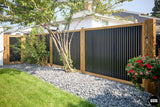
Black corrugated metal framed in western red cedar has become one of the most requested fence looks in Canada, and it's not just about style. Here's why the pairing works: the design contrast that makes it pop, and the durability, a non-combustible steel core plus naturally rot-resistant cedar, that makes it last.
-


How to Put Up Wire Mesh Fencing That Lasts
Got the panels? Now for the parts list. Here's what you actually use to put up wire mesh fencing, from posts and fasteners to tools and frost-depth footings, plus the panel spec that keeps your attachment points solid for decades.
-


Hog Wire vs. Stainless Deck Railing: The Canadian Cost Case
Searching "stainless steel deck railing near me"? Before you pay stainless prices, see how 6-gauge galvanized hog wire railing delivers the same open, modern look for a fraction of the cost, plus when true 316 marine-grade is actually worth it for Canadian decks.
-


Framed Hog Wire: The Open Fence for Patios and Decks
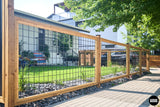
Wood framing with hog wire panels is the look defining Canadian patios and decks right now: open sightlines, airflow, and a boundary that doesn't box you in. Here's how to plan the layout, choose the frame wood, budget it, and pick a panel that won't rust at the welds.
-


Shopping for Hog Wire Fence Panels: What You Have, What You Need, and What Actually Lasts
You've got hog wire panels sitting in your yard, stacked in your garage, or bookmarked in six browser tabs. Maybe you inherited them with a property, maybe you bought a batch from a farm supply store and now you're wondering if they're actually fence-grade. Here's how to assess what you have in four checks, what specs actually matter when buying new, and how to make a decision you won't have to redo in five years.
-


Our Black Hog Wire Fence Panels Use a Dip-Coated Finish. Here's Why That Matters
You've probably seen black hog wire fence panels advertised everywhere. When you dig into what actually makes one panel last and another rust out in a few seasons, the finish is everything. Our panels are dip-coated rather than powder-coated, over hot-dipped heavy galvanized 6-gauge wire, and that combination is why we back them for 40 years while most competitors top out at 15.
-


Best BarrierBoss Hog Wire Panels for Inland Properties
If you live inland, your fence faces a different kind of punishment than coastal properties. No salt spray, but UV hammering through thin dry air, temperature swings from minus 40 to plus 35, alkaline soils, and wind that never really stops. Choosing the right hog wire panel for these conditions isn't about looks. It's about chemistry, wire thickness, and a finish that handles a 70-degree annual temperature delta without cracking, peeling, or corroding from the inside out.


Let customers speak for us
Great product.

Excellent product. Very rigid and good quality product. We live pretty remote and the delivery was as expected. I will buy from you again.

Love these panels, this is my second time using these for a client. shipping is a great deal if you are willing to wait a little. So just think ahead and you will be happy!
Great panels and delivery
3 of the 10 posts were warped and unusable. They had to be brought back to Barrier Boss and exchanged for straight posts.

Great communication, prompt pickup and worked through some potential headaches with excellent attitude. Would absolutely recommend
Happy with product, definitely not happy with delivery time but that has nothing to do with the product
Love these panels, this is my second time using these for a client. shipping is a great deal if you are willing to wait a little. So just think ahead and you will be happy!
Very nice and friendly gentleman who delivered.
Everything was great . Very positive experience and I would recommend using your company to any of my friends . Delivery Driver was awesome and has mad skills backing that big truck into tight spaces.

Brandon was excellent he dropped everything exactly where I wanted and was very helpful.
These tracks worked great, they do not have holes pre-drilled in them and are quite heavy duty. I preferred this a lot as I could cut and drill as needed!

Brandon was very pleasant and helpful. Great experience.
Awesome hogwire panels and very friendly & helpful delivery drivers! We went with a DIY unframed setup to minimize instructions to the view in the back yard. After our initial order, we decided to take advantage of the rewards credit and get a few extra panels to have on hand in case any get damaged. Both delivery drivers were very nice and respectful of the property. Since neither load was a crane truck, I was appreciative of their willingness to help me unload the panels by hand both times.
Good product and support mark was the delivery driver he did a great job will definitely order from them again
Brandon offered exceptional delivery service.